

Services
Production and Technology
We put live sport on air, and we build the productions on network technology rather than trucks and tie lines. That is what lets the same operation cover a club league night and a world championship.
01 · Production
Three ways to cover a game
The question is rarely whether a game can be covered. It is what level of production it justifies — and the honest answer differs between a national final and a Tuesday league draw.
- 01
On site
A crew in the building: vision mixing, replay, graphics and commentary from a production position at the venue. What a championship final or a broadcast partner normally expects.
- 02
Remote
The same production run from anywhere, over the venue’s connection. Nobody travels, so flights, hotels and per-diems leave the budget entirely — which is what makes covering a whole season, rather than a final, affordable.
- 03
Automated
No crew at all. The schedule starts and stops each broadcast, titles it and files the recording. Built for the games nobody would ever have paid a crew to cover — which is most of them.
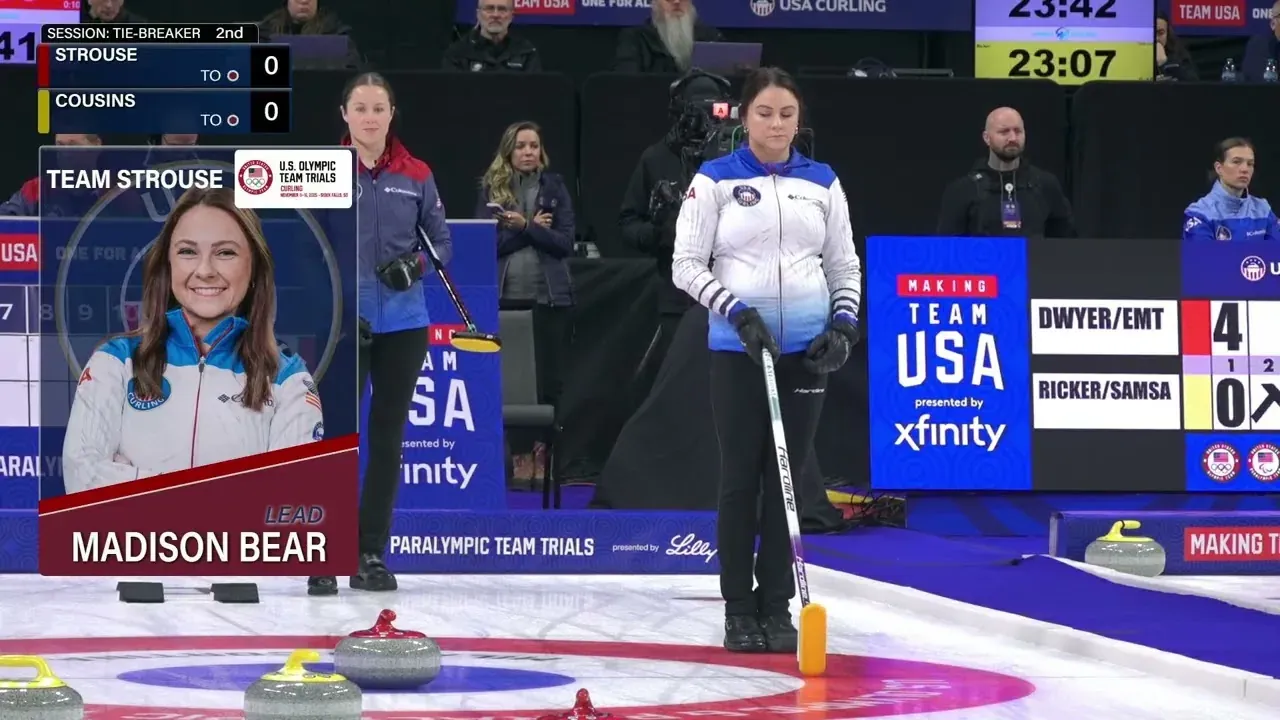 Watch on YouTube
A full SSN production: multi-camera coverage with live scoring, graphics and commentary.
U.S. Olympic Team Trials — women’s tie-breaker · Strouse vs Cousins
See it for yourself
What our coverage actually looks like
Multi-camera cutting, live scoring and graphics, commentary — the same production elements listed below, on air. Judge the standard from the footage rather than from a description of it.
More curling coverage, club level through championship, is on the Curling Stadium events page.
What a production includes
- Multi-camera cutting and camera control
- Scoreboards, clocks and live scoring
- Sponsor graphics and rotation
- Commentary, on site or remote
- Replay and highlights
- Stream monitoring and failover
Why our events can cost less
The saving is in the technology, not the building
We produce at plenty of venues that have nothing installed. There the saving comes from the technology rather than from the building: an IP-based rig scaled to the event, with as much of the crew working remotely as the event allows. Nothing permanent goes in, and it comes out again afterwards. It is a different sum from a pre-equipped venue, and we will tell you honestly which one you are looking at.
Either way, we produce for clubs, facilities, national governing bodies and world associations — the same operation, scaled to the event in front of it.

Cheaper still at a Curling Stadium venue
Most of what makes live sport expensive is temporary — trucks, rigging days, freight and travel. Where an event is held in a venue with a permanent Curling Stadium system, none of that applies: the cameras, switching and network are already in and already tested, so the event starts from a working system.
02 · Technology
We came to broadcast from IT
That is not a footnote — it is the reason our productions are put together the way they are. Traditional broadcast infrastructure is built from dedicated cabling, matrix routers and equipment that has to be in the same room. We build ours on networks, because everything that makes coverage affordable and repeatable follows from that one decision.
NDI
Video over the network instead of over dedicated cabling, so a camera, a replay machine and a graphics engine are all just addresses on a switch.
Dante
The same idea for audio: commentary, effects and mixes routed over IP, with clocking tight enough for live broadcast.
SRT
Getting a feed out of a building over ordinary internet and having it survive the packet loss that would break a plain stream.
WebRTC
Sub-second delivery, which is what makes genuinely remote production and two-way commentary workable rather than awkward.
HTML5 graphics
Scoreboards, clocks and sponsor rotations rendered in a browser engine, so they update live and can be redesigned without touching hardware.
Cloud and remote connectivity
Production, monitoring and archiving that do not depend on anyone being in the building, or on a specific building at all.
What that means in practice
Standards, not proprietary boxes — which is why a production can be reshaped for the event in front of it rather than the other way round.
- Feeds leave the venue over the connection it already has
- Broadcasts land on your own channels, under your own name
- The same feed to several destinations at once
- Operators work from wherever they are
- Every game recorded and archived, not just streamed
Every club we work with broadcasts to its own channel. See the curling channels currently on air.
Tell us what you want on air
Most people arrive knowing the event rather than how it should be produced. Give us the event, the venue and the dates, and we will work backwards from there.